

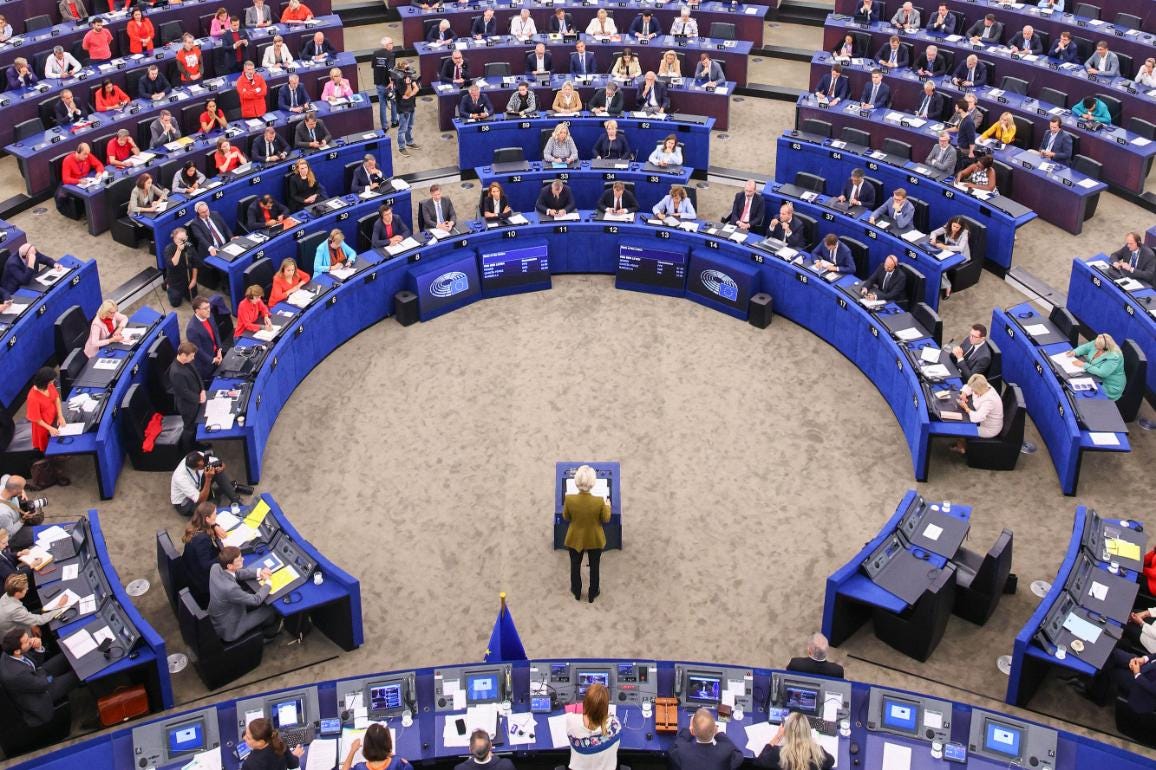
This State of the Union produced a familiar feeling: déjà vu, well-intentioned and naïve, as only we Europeans can be.
It offered incremental progress where the moment demands a quantum leap.
On security and political integration, Europe still hesitates to cross the Rubicon.
A European Security Council, an Emergency Security Protocol and another strategic instrument may all be useful. But they skip the harder questions of who decides, by what majority, with which democratic mandate, and who is ultimately prepared to act?
On the economy, the speech too often echoed the lobbying points of industries fighting decline rather than defining which capabilities must remain in Europe, and why.
Its determination to escape toxic dependencies was welcome. Yet the proposed answer was the traditional European inventory of packages, frameworks, funds and alliances. This is no time for bombastic announcements that inevitably unmask modest financial and political capital means.
Most striking of all was the silence on how the Union will pay for its ambitions. There were no references to the ongoing MFF negotiations, to significant new own resources, to common borrowing, or to fiscal capacity commensurate with the promises. Essentially, only the recurring hope that Europe’s fragmented private savings will somehow mobilise themselves.
On social media and the Israeli government’s excesses, the Commission President appeared to follow public sentiment rather than articulate a settled strategy. She was nevertheless willing to chastise member states over “gold-plating” (without properly explaining the practice or how another pact would stop it) and over their failure to act against Israel’s illegal E1 settlement project.
That firmness, however, vanished when it came to the integrity of the Schengen free-travel zone. She celebrated its freedoms without mentioning the systematic return of internal border checks or the Commission’s reluctance to enforce the rules against Italy and Spain, whose reciprocal air and sea controls have turned an exceptional safeguard into a political instrument. Austria now even invokes events in distant Ceuta to prolong its own checks without establishing a convincing connection. The guardian of the treaties seems increasingly reluctant to do its job.
Then came the improvised offer to make Canada the EU’s first “associate member.” The instinct, that of binding a democratic and strategically important partner more closely to Europe, is sound. Yet associate membership is not a ‘thing’ under the EU treaties. It would have to be designed, negotiated and reconciled with the Union’s legal order, decision-making institutions and obligations of membership.
Nor can such an invention be detached from enlargement. Nine formal candidate countries, and Kosovo as a potential candidate, have spent years, for Türkiye, decades, waiting in line, transposing European law and navigating a demanding, supposedly merit-based process. What message does a bespoke Canadian status send to them?
Flexible geometry may be necessary, but improvisation from the podium may not favour the emergence of a badly needed enlargement doctrine. The fact that CETA itself remains incompletely ratified only sharpens the irony.
Finally, the proposed “Congress of Europe” recalled the Conference on the Future of Europe (another exercise in continental introspection), only this time led by the ‘best and brightest’ (back in fashion after Draghi’s Rhine Group!), with citizens and civil society invited into the supporting cast. It already feels like the chronicle of another death foretold.
Once again, a president unwilling (or incapable) to take political risks has distilled collective wisdom into technocratic fixes: sensible, earnest, but unequal to the hour.
Europe’s problem has never been a shortage of diagnoses, roadmaps or frameworks (that’s a thriving business in Europe!).
It is the widening gap between the clarity of its diagnoses and its willingness to project the political power needed to act on them.
In a democratic environment, political power can only spring from an electoral mandate. Which the Commission doesn't have, by design... the need to change the Treaties has never been greater.
A presidente da CE não tem legitemidade democráica para dar opiniões sobre estratégias para a UE que competem ao parlamento Europeu e Conselho Europeu
Por outro lado nao fala sobre questões que são da sua responsabilidade como orgão executivo como é referido no texro
Ursula têm demonstrado incompetência nas propostas que faz e espirito Belicista a reboque do Sec Geral da Nato .São desajustadas á urgência de medidas concretas que promovam
o desenvolvimento científico e económico da UE em ambiente de Paz na Europa